Content marketing has never been static. However, in recent years, shifts in consumer behavior have accelerated the content marketing evolution, forcing brands to rethink how they create, distribute, and measure content. Audiences today are more informed, more selective, and more empowered than ever before.
As digital touchpoints multiply and attention spans fragment, content marketing is no longer about volume—it is about relevance, consistency, and value across the entire customer journey.
The Changing Nature of Consumer Behavior
Consumers Are More In Control Than Ever
Modern consumers actively choose what content they consume, when they engage, and which brands they trust. They skip ads, block interruptions, and gravitate toward content that aligns with their needs and values.
This behavioral shift has played a major role in the content marketing evolution. Brands can no longer rely on one-way messaging; they must earn attention through usefulness and authenticity.
Trust and Credibility Drive Engagement
Consumers increasingly evaluate content based on credibility. Educational, transparent, and experience-driven content outperforms overtly promotional messaging.
As a result, content marketing is evolving from brand-centric storytelling to audience-centric value creation.
From Volume to Value: A Core Shift in Content Marketing Evolution
Quality Outweighs Quantity
In the past, publishing frequently was often seen as the key to visibility. Today, saturation has changed that equation. Audiences are overwhelmed with content, making quality and relevance critical.

High-performing brands now focus on:
- Fewer, higher-quality content assets
- Deeper insights rather than surface-level topics
- Content that solves real problems
This shift reflects a broader content marketing evolution toward sustainable, long-term impact.
Content as a Long-Term Asset
Content is increasingly treated as a strategic asset rather than a campaign deliverable, reflecting how brands are rethinking the balance between content vs. campaign for long-term and short-term impact.Evergreen articles, guides, and thought leadership pieces continue delivering value long after publication.
Agencies such as Quickspace Marketing Management L.L.C often advise brands to invest in cornerstone content that supports long-term visibility and trust, rather than chasing short-lived engagement spikes.
Personalization and Context Are Becoming Essential
Behavioral and Intent-Based Content
Consumer behavior data now informs content creation at a deeper level. Brands use insights from search intent, browsing patterns, and engagement history to tailor content more precisely.
This approach allows content to:
- Match the audience’s stage in the buyer journey
- Address specific pain points
- Deliver the right message at the right time
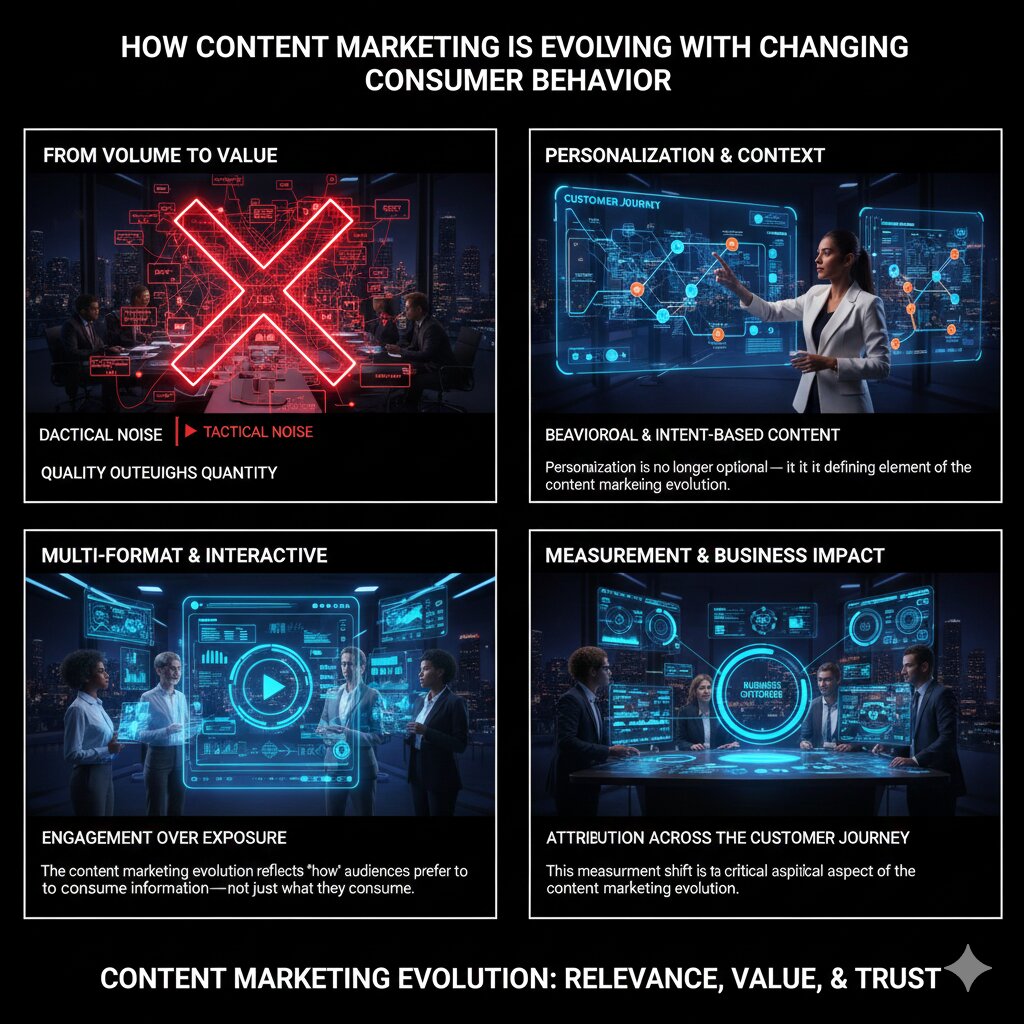
Personalization is no longer optional—it is a defining element of the content marketing evolution.

Platform-Specific Content Experiences
Consumers behave differently across platforms. What works on social media may fail in email or search. Modern content strategies account for platform context while maintaining consistent messaging.
This balance between adaptation and consistency is a key challenge brands must master.
The Rise of Multi-Format and Interactive Content
Beyond Text-Based Content
While written content remains foundational, changing consumer behavior has driven demand for diverse formats, including:
- Short-form video
- Interactive tools and calculators
- Visual explainers and infographics
- Podcasts and audio content
The content marketing evolution reflects how audiences prefer to consume information—not just what they consume.
Engagement Over Exposure
Interactive content encourages participation rather than passive consumption. This increases engagement, time spent, and memorability—metrics that matter more than raw impressions.
Brands that experiment with interactive formats often see stronger performance across the funnel.

Content Distribution Is as Important as Creation
Owned, Earned, and Paid Must Work Together
Creating great content is only part of the equation. Distribution strategies now play a critical role in content success.
Effective content marketing evolution involves:
- Aligning SEO, social, email, and paid promotion
- Repurposing content across channels
- Ensuring consistent visibility without repetition
Content that is not strategically distributed rarely achieves its full potential.
Community and Relationship-Based Distribution
Brands increasingly rely on communities, partnerships, and owned audiences rather than algorithm-dependent reach. Email lists, private groups, and subscriber-based channels provide stability in an unpredictable digital landscape.
Measurement Is Shifting Toward Business Impact
Moving Beyond Vanity Metrics
Likes, shares, and views no longer define success, reinforcing why digital performance metrics that actually matter are becoming central to modern content strategies. Modern content marketing focuses on metrics tied to business outcomes, such as:
- Lead quality
- Conversion influence
- Customer retention
- Lifetime value contribution
This measurement shift is a critical aspect of the content marketing evolution.
Attribution Across the Customer Journey
Content often influences decisions indirectly and over time. Brands are improving attribution models to understand how content supports awareness, consideration, and conversion collectively—not in isolation.
Challenges Brands Face During This Evolution
Maintaining Consistency at Scale
As content expands across platforms and formats, maintaining consistent messaging becomes more difficult. Without clear governance, content efforts can fragment quickly.
Balancing Speed and Depth
Consumer behavior evolves rapidly, but meaningful content still requires research and strategic thinking. Brands must balance agility with substance.
What the Future of Content Marketing Looks Like
The content marketing evolution is moving toward:
- Deeper audience understanding
- Integrated content ecosystems
- Stronger alignment with business strategy
- Long-term trust building rather than short-term visibility
Brands that succeed will treat content as a system—not a series of disconnected outputs.
Content Marketing Evolution as a Strategic Advantage
As consumer behavior continues to change, content marketing must evolve with it. Brands that prioritize relevance, value, and consistency will stand out in crowded digital environments.
By understanding and embracing the content marketing evolution, organizations can create content that not only captures attention—but builds lasting relationships, supports growth, and delivers measurable business impact in the long term.